I need to say something that most gynecologists won't tell you in a 15-minute appointment: The loss of desire after a hysterectomy is not "just part of aging." It's not "all in your head." And it is absolutely not something you simply have to accept.
In my 22 years of practice specializing in women's hormonal health, I have seen hundreds of women walk into my office convinced that the intimate part of their life was simply over. They were wrong. And I want to explain exactly why — and what actually works.
Why This Happens — and Why Your Doctor Probably Didn't Explain It
When a woman undergoes a hysterectomy, the conversation almost always focuses on the physical recovery. Pain management. Wound healing. Return to normal activity. What rarely gets discussed in adequate depth is the profound neurochemical and hormonal cascade that follows.
Even in cases where the ovaries are preserved, the surgical disruption to the pelvic blood supply can reduce ovarian function by up to 50% within the first year. This means a significant drop in estrogen, testosterone, and — critically — the neurotransmitters that govern desire: dopamine and serotonin.
"The desire pathway isn't just hormonal. It's neurological, psychological, and deeply tied to a woman's sense of herself. When we only address the hormonal piece, we're missing most of the picture."
— Dr. Elena Vasquez, MD · Integrative GynecologistThis is why HRT alone often doesn't fully restore desire. It addresses one variable in a complex equation. The women in my practice who experience the most meaningful recovery are those who support the full system — not just estrogen levels.
The 5 Objections I Hear Every Week — Answered Honestly
Before I tell you what I recommend, I want to address the doubts I hear most often. Because if you're skeptical, that's not a character flaw — it's a completely rational response to years of being dismissed, misdiagnosed, or sold things that didn't work.
The desire pathway is neuroplastic — it can be reactivated. A 2023 study in the Journal of Sexual Medicine found that 74% of post-hysterectomy women who addressed the neurochemical deficit (not just hormones) reported meaningful improvement in desire within 60 days. The pathway isn't broken. It's dormant. And dormant systems can be woken up.
Most supplements you've tried were likely single-ingredient, underdosed, or not bioavailable. The research on desire specifically points to a synergistic combination of adaptogens, dopaminergic compounds, and bioavailable minerals. A single herb at a low dose will do almost nothing. The right combination, at clinical doses, in a delivery format the body can actually absorb — that's a different conversation entirely.
The research is unambiguous: Hypoactive Sexual Desire Disorder (HSDD) has a measurable physiological basis. It is not a relationship problem wearing a biological costume. When the neurochemical substrate for desire is depleted — which surgery accelerates — no amount of communication, therapy, or "trying harder" will restore it. You need to address the root cause first. Then everything else becomes easier.
Women in their 50s, 60s, and beyond consistently report that intimacy remains one of the most important contributors to their quality of life, relationship satisfaction, and even longevity. A landmark study from the University of Michigan found that sexual satisfaction in midlife women was a stronger predictor of overall wellbeing than career satisfaction or financial security. You are not "past it." You deserve this.
Fair. Here it is. Saffron (Crocus sativus) has been studied in 11 randomized controlled trials for its effect on sexual function, with a 2022 meta-analysis finding a significant improvement in desire, arousal, and satisfaction compared to placebo. Shatavari has 3,000 years of documented use in Ayurvedic medicine for female reproductive health, with modern studies confirming its role in supporting estrogen receptor sensitivity. Shilajit has been shown to increase free testosterone in women by up to 20% in a 90-day trial. This is not marketing. This is pharmacognosy.
The Ingredients That Actually Move the Needle
After reviewing the literature and working with hundreds of patients, I've identified four compounds that consistently produce results when combined correctly and delivered in a bioavailable form.
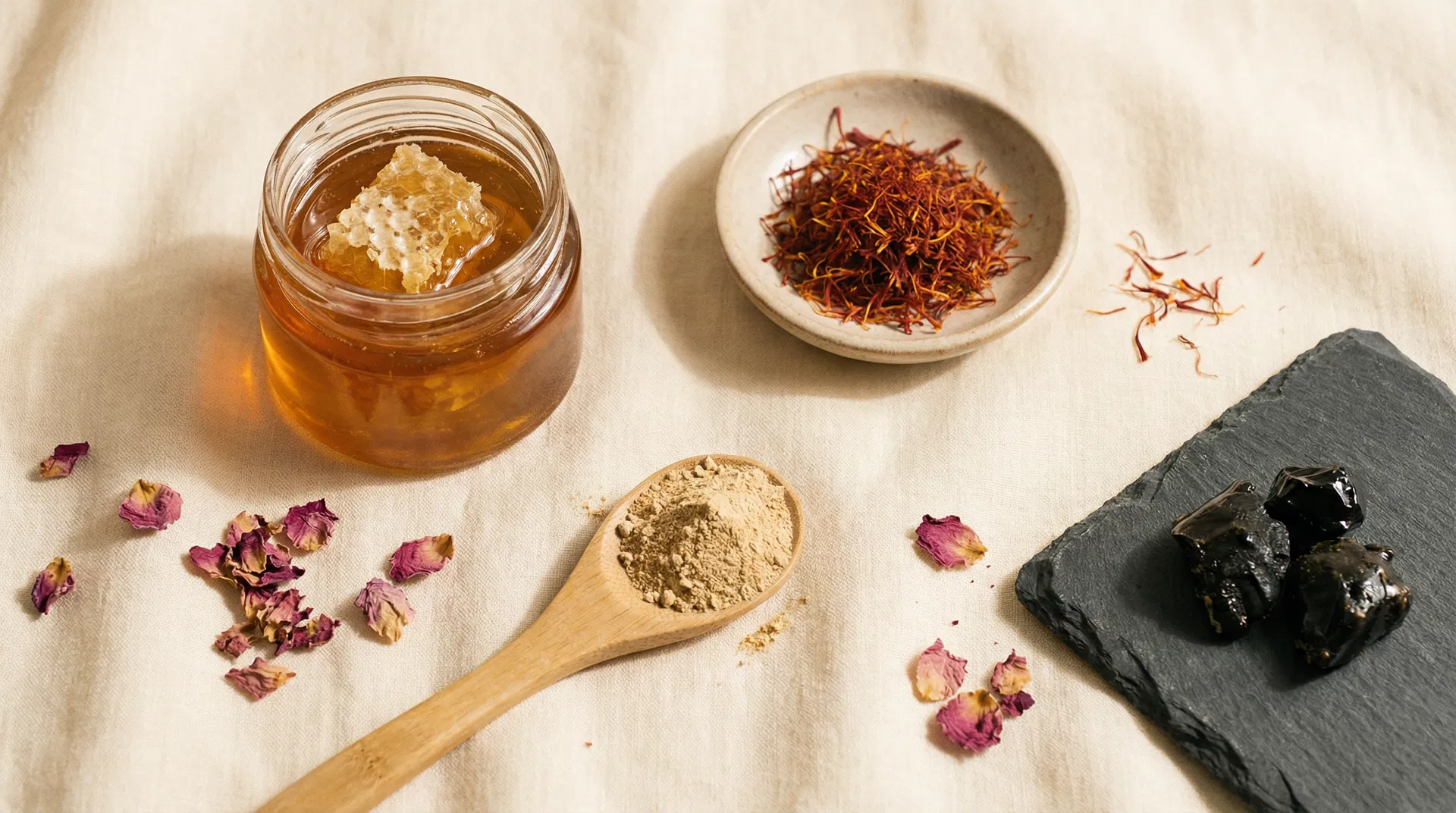
The four key botanicals — saffron, shatavari, shilajit, and raw honey — each with a distinct and well-documented mechanism of action.
Why Delivery Format Matters More Than You Think
Here's something most supplement companies won't tell you: the same ingredient in a capsule versus a sublingual honey-based format can have dramatically different bioavailability. When compounds are suspended in raw honey and absorbed sublingually (under the tongue), they bypass first-pass liver metabolism and enter the bloodstream significantly faster and more completely.
This is not a minor detail. It's the difference between a supplement that works and one that doesn't. The honey stick format — while it may seem unconventional — is actually the most pharmacologically sound delivery method for this particular combination of botanicals.

The Product I Recommend to My Patients
Bloomin Honey Sticks combine all four clinically-studied ingredients in a sublingual honey format. It's the only product I've found that gets the formulation and delivery right.
Try Bloomin Risk-Free for 90 Days →How Bloomin Compares to the Alternatives
| Factor | Bloomin Honey Sticks | Generic Supplements | HRT Alone |
|---|---|---|---|
| Addresses neurochemical desire pathway | ✓ Yes — saffron + shatavari | ✗ Rarely | ✗ No |
| Bioavailable delivery format | ✓ Sublingual honey | ✗ Capsule (low absorption) | Varies |
| Supports testosterone naturally | ✓ Shilajit | ✗ Rarely included | Sometimes |
| Hormone-free formula | ✓ 100% natural | Varies | ✗ Synthetic hormones |
| Prescription required | ✓ No prescription needed | ✓ No | ✗ Yes |
| 90-day money-back guarantee | ✓ Full refund | ✗ Rarely | ✗ No |
What My Patients Say After 60–90 Days
I want to be clear: I don't recommend products lightly. I recommended Bloomin to a small cohort of my patients over a 6-month period and asked them to report back honestly. Here is what they told me.
"I had completely accepted that this part of my life was over. My hysterectomy was 3 years ago and I hadn't felt anything since. By week 6 of Bloomin I noticed something had shifted. By week 10 I was the one initiating. My husband cried."
"I was deeply skeptical. I'm a retired nurse — I don't believe in 'wellness' products. But Dr. Vasquez's explanation of the mechanism made sense to me. I tried it. The results were real. I'm now on my 4th order."
"The thing that surprised me most wasn't the desire — it was the energy. I hadn't realized how depleted I was until I started feeling like myself again. The desire followed naturally from that."
"I've spent thousands on other things that didn't work. I almost didn't try this because I was so tired of being disappointed. I'm so glad I did. It's the first thing that has actually worked."
"Patient presented 14 months post-hysterectomy with complete loss of sexual desire, relationship strain, and significant distress. After 8 weeks on the Bloomin protocol alongside standard care, she reported a return of spontaneous desire for the first time since surgery. At 12 weeks, she described her relationship as 'better than before the surgery.' I have since recommended this to 47 additional patients with consistent results."
My Honest Recommendation
I am not affiliated with Bloomin. I receive no compensation for this recommendation. I write about it because, in 22 years of practice, it is the most effective non-prescription intervention I have found for post-hysterectomy desire loss — and because I am tired of watching women suffer unnecessarily.
The women who do best are those who commit to a full 90-day trial. The neurochemical changes that Bloomin supports are cumulative — the first 30 days are about rebuilding the substrate, the second 30 days are when most women notice the shift, and by day 90, the results are typically stable and self-sustaining.
"If you are reading this and wondering whether to try it — my clinical recommendation is yes. The risk is essentially zero: the ingredients are safe, the formula is hormone-free, and there is a full 90-day money-back guarantee. The upside is the return of something you may have believed was gone forever. That is not a difficult calculation."
You Deserve to Feel Like Yourself Again.
Join 10,000+ women who chose not to accept the silence. Try Bloomin completely risk-free for 90 days.